EBICS Explained: The Standard for Secure Bank Communication in Treasury Management
Updated: Jul 21

Several banks, different portals, many Excel lists and recurring manual downloads and uploads. This used to be the daily finance reality for many mid-sized companies. With increasing digitalisation, these processes are becoming more sensitive, as secure bank communication is crucial for finance departments.
EBICS established a standard for the secure exchange of data between companies and banks. It replaced older systems such as BCS-FTAM and can simplify payment processes for companies. EBICS is now also well established among German small and medium-sized enterprises.
Especially in treasury management, liquidity planning and cash management, EBICS can contribute to greater transparency. This article explains what EBICS means, how it works and how mid-sized companies can use it.
What Is EBICS? Definition and Meaning
EBICS stands for Electronic Banking Internet Communication Standard. It is a secure communication standard for electronic data exchange between companies and banks.
Companies often use EBICS in connection with finance or treasury systems. The reason: ERP and TMS systems can be connected directly to the bank via EBICS.
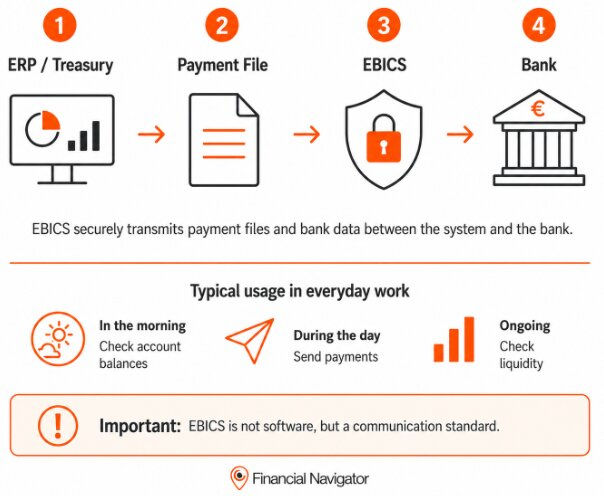
Through this standardised channel, payment data, account statements and bank information can be transmitted, retrieved and transferred into internal systems automatically. This reduces manual processes and creates a better overview in liquidity planning.
EBICS is not software, not a number and not an online account. In online banking, users work manually in a bank portal. EBICS can be seen as a transport route: the standard through which data is transmitted.
How Does EBICS Work in Day-to-Day Business?
In day-to-day business, EBICS makes it possible to automate bank data and payment processes between company software and the bank. The process can be simplified as follows:
The company uses EBICS-enabled software.
The software establishes a secure connection to the bank.
Account statements, payment files or bank information are transmitted.
Approvals and signatures ensure that payments are authorised.
The bank processes the submitted files and provides feedback.
Through direct software-bank communication, employees no longer have to log in manually to several portals and platforms.
Written signatures are replaced by electronic signatures. However, this does not mean that the process is less secure. The multiple-eyes principle also applies with EBICS. A payment is not approved by one single person, but must be authorised by authorised users.
A practical example:
A mid-sized manufacturer has accounts with three banks. Every morning, the finance team needs to know which payments have been received and what liquidity is available. Through EBICS, the account statements are automatically imported into Financial Navigator. The team sees the current cash position centrally and can update forecasts faster.
Why EBICS Is Important for Treasury Management
Treasury management is about the active management of liquidity, payment flows, bank accounts and financial data. For this, finance teams need current and reliable data. In cash positioning, for example, the available means of payment a company has are analysed almost daily.
With a lot of manual work, errors and delays can quickly occur. EBICS makes it possible to retrieve bank information automatically and in a structured way and therefore improves the data basis.
As a result, CFOs and finance teams gain:
More transparency over their liquidity.
Better forecasting and cash flow management.
Faster and more reliable reports.
A major efficiency driver of EBICS is multibank connectivity. It offers one central channel for several banks. This automation saves time, reduces manual work and improves data quality.
Centralised management
Structured and standardised processes
Better data quality
More precise liquidity and cash flow management
Stronger treasury governance
Setting Up EBICS: What Companies Should Consider
Since EBICS is not software, it cannot simply be “installed”. Companies therefore need an EBICS-enabled ERP system or TMS and should consider the following steps.
Registration and Bank Activation
First, the bank must be contacted and EBICS access must be requested. This is usually done through the corporate customer portal or an application form from the bank. Normally, the bank activates EBICS access within 2 to 5 working days.
User Roles and Signatures
After activation, user roles should be defined. User roles and different signature classes determine which user has which rights. This keeps control in place and approval processes are designed according to the four-eyes principle.
Integration Into Treasury Systems
The greatest added value arises when EBICS data becomes usable in the treasury system. This means that data for cash management, liquidity planning, forecasting and reporting can be used directly and with few manual processes.
Typical Challenges During Implementation
Most obstacles are not technical, but organisational. It is therefore important to clearly define roles and processes before implementation. Typical challenges are:
Different bank processes
Missing technical information
Unclear user rights
Coordination between finance, IT and the bank
Tests with payment data
Clean data structure in the treasury system
Change management in the finance team
EBICS vs. PSD2: What Is the Difference?
PSD2 is a European payment services directive that was created for payment services in the internal market. EBICS and PSD2 are often mentioned in the same context because both concern payment and banking processes. However, they serve different purposes.
Criteria | EBICS | PSD2 |
What is it? | Communication standard | EU regulation |
Focus | Bank communication for companies | Payment services and account access |
Typical use | Payment files, account statements, multibank processes | Open banking, account information, payment initiation |
Target group | Companies, banks, treasury | Banks, users, payment service providers, third-party providers |
Benefit for treasury | High benefit for automation and multibank processes | Relevant depending on the use case, but often less deep for classic treasury processes |
Who Is EBICS Suitable For?
EBICS is especially relevant when companies want to move from manual processes to efficient automation. For growing mid-sized companies or international firms, EBICS can be a major lever.
It makes day-to-day finance work much easier and therefore helps CFOs, finance managers and controllers work more efficiently and make more informed decisions.
Mid-Sized Companies With Several Banks
One of the most important use cases for EBICS is multibank connectivity. If a company works with several banks, it is much harder to keep a consistent overview of daily payments. EBICS helps regain this overview and makes information from different bank connections centrally available.
Companies With High Payment Volumes
With high payment volumes and many manual payments, errors can occur more quickly. This is time-consuming and increases the need for control. EBICS helps standardise payment files and approval processes.
Finance Teams With Complex Approval Processes
In larger finance teams, not every person is allowed to approve every payment. EBICS setup supports the implementation of clear signature and role models. This reduces risks and makes complex processes easier to standardise.
Using EBICS With Financial Navigator
Financial Navigator is an EBICS-enabled Treasury Management platform for efficient financial management.
EBICS supplies bank data and enables standardised payment and information processes. Financial Navigator bundles this data centrally and enables more transparency. This overview provides a better data basis for liquidity planning, reporting and cash flow forecasting.
As a modern treasury platform, Financial Navigator is the ideal solution for mid-sized companies looking for efficient alternatives to manual processes. It is faster and more focused than overloaded ERP projects and supports liquidity planning and cash flow transparency.
Request a free demo now and use EBICS data centrally in treasury.
Conclusion: Why EBICS Is Becoming Important for Modern Finance Departments
EBICS is a communication standard and enables secure data exchange between banks and companies. The benefits of EBICS include:
Data centralisation
Process automation
Standardisation
Clear definition of roles and rights
Transparency and reduced risk
EBICS is highly relevant for treasury and cash management teams. The greatest added value arises when EBICS is combined with a Treasury Management System. Mid-sized companies in particular can benefit from EBICS and a TMS such as Financial Navigator.
Request a demo now and centralise treasury processes.


