SWIFT: Definition, Explanation and Use in Treasury Management
Updated: Jul 21

SWIFT is one of the world’s most important networks for financial messages. Around 44 million messages per day and 150 trillion US dollars in payment volume per year run through this system. It is almost impossible to process international payments without SWIFT.
For CFOs and finance teams, it is important to understand and use SWIFT. Correct payment data, secure bank communication and transparent processes are necessary to reduce operational risks. This article explains what SWIFT is and how it is used in treasury management.
What Is SWIFT? The Basic Definition
SWIFT is a global communication network. It is not a bank and should not be equated with the IBAN. The Deutsche Bundesbank describes it as a provider of global communication services. The actual payment is carried out through banks and payment systems.
What Does SWIFT Stand For?
SWIFT stands for Society for Worldwide Interbank Financial Telecommunication. In German, this means roughly: worldwide society for financial telecommunication between banks. It was founded in 1973 as a Belgian cooperative by 239 banks. It developed from Telex communication into modern IP infrastructure.
SWIFT is often associated with the SWIFT code and BIC. Here are the most important abbreviations explained:
Term | Full form | Function |
SWIFT | Society for Worldwide Interbank Financial Telecommunication | Global network for financial messages |
BIC | Business Identifier Code | Code for identifying a bank or financial institution |
SWIFT-CODE | Another term for BIC | |
IBAN | International Bank Account Number | International account number |
SEPA | Single Euro Payments Area | European payment area for standardised euro payments |
How Does the SWIFT Network Work?
When a payment is processed with SWIFT, the message flow looks as follows:
A company or customer initiates a payment
The bank needs payment data such as recipient, account details and BIC code
Standardised messages are exchanged between the participating banks via SWIFT
The payment is processed via the participating banks and payment systems
In the end, SWIFT can be compared with a secure, standardised message language for banks. SWIFT is especially relevant for cross-border payments, also for mid-sized companies that grow internationally and work with several banks.
Why SWIFT Is Important for Treasury Management
SWIFT offers a high security standard, multibank connectivity and transparency. This gives treasury teams real-time payment monitoring and standardised communication with more than 11,000 institutions in over 200 countries.
Treasury Management Systems like Financial Navigator can automate SWIFT payments and manage payment processes centrally through one platform.
Discover Financial Navigator’s solutions and book a free demo.
Security in the SWIFT Network
In 2016, a group of hackers managed to divert $81 million from the Central Bank of Bangladesh to the Philippines. They used compromised systems to trigger fraudulent SWIFT messages.
This incident demonstrated that a secure network is no substitute for a company’s own internal controls. Following this, SWIFT further tightened its security requirements, including through:
Customer Security Programme: mandatory security programme for participating institutions
Independent audits: regular review of IT security by external or independent auditors, self-assessments no longer recognised
Extended security guidelines: two-factor authentication, four-eyes principle, standardised approvals and fewer manual processes
The case also shows that automation can strengthen not only efficiency but also security in treasury management.
The SWIFT Code, BIC: Structure and Meaning
BIC or SWIFT codes follow the ISO 9362 structure. The code identifies a bank, financial institution or business unit. The correct maintenance of such bank data is important. An incorrect or incomplete BIC can lead to queries, delays or manual checks.
How Is a BIC Code Structured?
A BIC code usually has 8 or 11 characters and consists of a bank code, country code, location code and optional branch code.
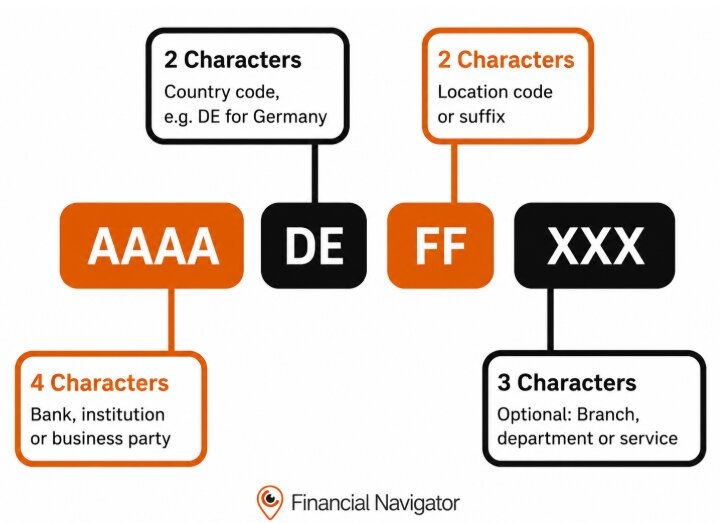
The BIC code of Deutsche Bank would be DEUTDEDB, for example, or COBADEFFXXX for Commerzbank.
It is important to note that a code that looks formally correct is not automatically the right code for a specific bank connection, subsidiary or payment type. Bank data should therefore always be checked for new recipients.
Where Can I Find My Bank’s SWIFT Code?
The BIC code can usually be found in online banking, on account statements, in bank documents, on the bank’s website or in the recipient’s payment information. Finance teams should also check:
Does the code come from an official source?
Does it belong to the right bank or company?
Do the recipient name, IBAN and bank country match?
Has a change in bank data been approved internally?
SWIFT GPI: Faster and More Transparent International Transfers
SWIFT GPI stands for SWIFT Global Payments Innovation. It was introduced in 2017 to improve international payments. The focus is on:
Real-time tracking
Higher speed
Fee transparency
International payments usually run through several banks. This can lead to delays or unclear fees. SWIFT GPI makes payments easier to track. Finance teams can know exactly where a payment is, when it is expected to arrive and what fees apply.
This transparency supports liquidity planning and improves communication with suppliers and recipients.
SWIFT in Germany: Why It Is Becoming More Important for Mid-Sized Companies
Germany is one of the most active SWIFT members. The Deutsche Bundesbank, for example, is part of the cooperative oversight of SWIFT with other central banks. As one of Europe’s strongest economies with high export rates, many international payments are made via SWIFT.
Internationalization and exports are also on the rise among small and medium-sized enterprises. Supply chains span multiple countries, and payments in foreign currencies are increasing. SWIFT is therefore highly relevant for small and medium-sized enterprises. It helps them better manage payments, liquidity, and the quality of banking data despite increasing complexity.
SWIFT vs. SEPA: When Does Which System Apply?
SEPA stands for Single Euro Payments Area and describes the zone in Europe where payments are made uniformly in euros. SEPA and SWIFT overlap in payment transactions, but they fulfil different functions.
Criteria | SWIFT | SEPA |
Area of use | International bank communication and payment messages. | Euro payments within the SEPA area |
Typical use | International transfers, payments outside Europe, payments in foreign currency | Euro transfers, SEPA direct debits, SEPA instant transfers |
Relevance for companies | For international business relationships, suppliers, customers or bank accounts outside the SEPA area | Euro payments within Germany and Europe |
Required information | BIC / SWIFT code, recipient bank, account data or IBAN, country-specific information | Recipient’s IBAN, additional data depending on payment type |
Advantage | Global reach, standardised communication between banks | Simplifies and standardises euro payments within SEPA |
Automating SWIFT Payments With Financial Navigator
Despite SWIFT, many manual processes within a company can increase the risk of errors and delays.
Treasury Management Systems like Financial Navigator make it possible to manage payments centrally. SWIFT transactions can be processed in real time and connected with banks and ERP systems. Financial Navigator offers over 13,000 bank integrations and a real-time overview of all transactions. This makes treasury management and liquidity planning easier, as it offers full transparency and control.
For payments in the SWIFT network, this means:
Payment data from ERP or finance systems can be transferred
Payments can be checked and approved centrally
International payments across several banks can be managed through one platform
Mid-sized companies in particular often work with several banks and have little automation. Financial Navigator can be used exactly here to improve treasury workflows and financial management.
Why Companies Should Now Classify SWIFT Strategically in Payment Transactions
SWIFT is a global network for standardised financial messages. With the help of the BIC code, banks and institutions can be clearly identified. SWIFT GPI also strengthens transparency and tracking.
While SEPA is relevant for standardised payments within Europe, SWIFT supports secure international payments and bank communication abroad.
With a Treasury Management System like Financial Navigator, mid-sized companies can manage complex payment processes:
Centrally
With standardised approvals
Automatically
With more transparency and with greater control
If your company wants to manage international payments more efficiently, Financial Navigator offers solutions for more transparency, control and security in treasury.
Book a free demo today.


